
 Mon - Fri 10:00AM - 4:00PM
 18911 Hardy Oak Blvd Ste. 103
 210 446 9069




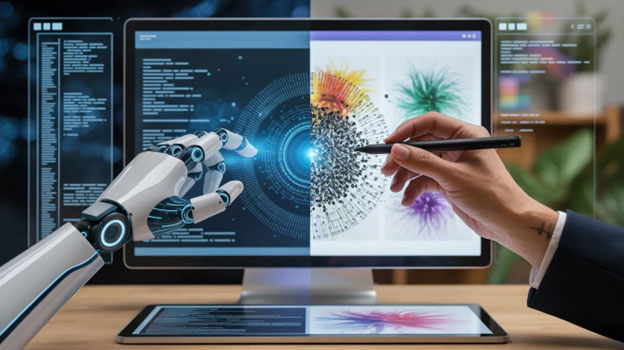
A New Era for the Web
Every few decades, a wave of technology reshapes what it means to build for the internet. We went from plain HTML pages to CSS layouts, then to responsive design, mobile-first development, and component-based frameworks. Each wave changed the tools, but the fundamentals of design, people creating experiences for other people, stayed the same.
Today, artificial intelligence is threatening to change even that. Tools now exist that can generate a fully structured, visually styled website from a single sentence of plain text. AI can write code, create custom images, suggest layouts, and audit accessibility, all in seconds. The question on every designer’s mind is no longer whether AI will impact their field, but how deeply, and how soon.
This article cuts through the hype and examines both sides clearly: what AI is genuinely capable of today, where it still falls short, and what the most likely future looks like for the designers navigating this shift.
What AI Can Already Do
The capabilities of AI design tools have accelerated dramatically. What was experimental just three years ago is now remarkably functional. Here is what AI can handle today:
Instant Website Generation
Platforms like Framer AI, Wix ADI, and Durable can generate a complete, styled website, header, navigation, sections, footer, from a short text description. This is not template-filling. These systems make real decisions about layout hierarchy, color palettes, and typography to match the described purpose of the site.
Code Writing and Layout Assistance
Tools like GitHub Copilot and ChatGPT can write clean HTML, CSS, and JavaScript on demand. Inside design tools like Figma, AI suggests alignment, spacing, and grid improvements in real time. Designers who once needed coding skills to prototype certain interactions can now describe what they want and receive working code instantly.
Custom Image and Asset Creation
Midjourney, Adobe Firefly, and DALL-E can generate professional-quality illustrations, backgrounds, and hero images from a text prompt. This removes the need to search stock libraries or hire illustrators for every project, saving significant time and budget on early-stage work.
The Speed Impact
Tasks that once took a designer 4–6 hours, mood boards, wireframes, initial CSS, can now be produced in under 30 minutes with AI assistance. Teams that previously spent two weeks on initial concept exploration now spend two days, leaving far more time for refinement, testing, and strategy.
The clearest impact of all this is speed. AI does not just make designers faster. It shifts where their time goes. Less time building from scratch, more time evaluating, refining, and making the strategic decisions that actually determine whether a website succeeds.
Where AI Falls Short
Despite impressive capabilities, AI design tools have clear and consistent limitations. Understanding them is key to understanding why human designers are not going away.
Emotional Intelligence and Context
AI is outstanding at pattern recognition. It has learned from millions of websites what layouts tend to work, what color combinations are pleasant, and what structures guide the eye. But understanding why a design needs to make a specific person feel a specific thing, trusted, inspired, safe, excited, is a deeper kind of knowledge.
The homepage of a children’s cancer charity and the homepage of a luxury car brand both need to be ‘good design.’ But what that means is completely different for each. The charity needs to communicate empathy and hope. The car brand needs to project power and aspiration. These tones require a designer who understands human emotion from the inside, not a model that has seen many charity websites.
Cultural Nuance
Design is not culturally neutral. Colors carry different meanings across cultures. Layout direction, visual hierarchy, and imagery conventions vary enormously between markets. AI tools trained predominantly on Western, English-language content frequently produce designs that feel subtly wrong for other cultural contexts, a limitation that has real consequences for global brands and local businesses alike.
Strategic Business Thinking
A website is a business tool, not just a visual object. The design decisions on a site, what goes above the fold, where the call to action lives, how navigation is structured, directly affect conversion, retention, and revenue. Making these decisions well requires understanding the specific business deeply: its goals, its users, its competitors, and its constraints. AI can apply general best practices, but it cannot attend a strategy meeting, synthesize contradictory stakeholder opinions, or make a considered judgment call rooted in a deep understanding of the business.
Original Creative Vision
AI is, by its nature, a pattern-completion engine. It produces the most statistically likely output based on what it has seen before. It is structurally inclined toward the conventional and the expected, because the conventional is what appears most in training data. The creative risk-taker who deliberately breaks convention in service of a bold idea is doing something AI is not designed to do. That creative daring must come from a human, even when AI helps execute the vision.
The Core Limitation
AI can optimize for patterns it has already seen. It cannot originate a genuinely new idea, feel the emotional weight of a design problem, or make a courageous creative choice in defiance of convention. These are not technical gaps that future updates will close. They reflect a fundamental difference between pattern recognition and human creative experience.
How Designer Roles Are Changing
AI is not eliminating design as a profession. It is restructuring what designers spend their time on and where their value lies.
From Builder to Director
The most significant shift is from building to directing. In the past, a designer’s day was largely spent in execution: drawing wireframes, setting up grids, writing CSS, hunting for photography. AI is increasingly automating these tasks. The designer’s primary value now lies in directing the work, deciding what direction to pursue, evaluating what AI produces, rejecting what misses the mark, and refining what gets close.
This is a positive evolution for experienced designers who found mechanical execution the least satisfying part of their work. It is harder for junior designers whose learning path traditionally ran through years of hands-on execution practice.
New Skills That Matter Most
Designers who are thriving in the AI era share a common set of evolving skills:
- Deep user empathy, understanding people at a psychological and emotional level, not just through data
- Strategic business acumen, connecting design decisions to measurable outcomes
- Aesthetic courage, developing a strong personal creative vision and the confidence to pursue it
- AI fluency, knowing how to direct AI tools effectively and evaluate their output critically
- Cross-disciplinary thinking, bridging design, psychology, technology, content, and business strategy
The designers who will struggle are those who resist engaging with AI tools at all, or who rely exclusively on AI output without bringing genuine human judgment to bear. The ones who will excel are those who treat AI as a powerful instrument that amplifies their own creative intelligence.
What the Future Actually Looks Like
The framing of ‘AI versus humans’ is ultimately a distraction. The more accurate and useful frame is augmented collaboration. AI and human designers working together, each contributing what they do best.
AI will handle the automatable: scaffolding, repetitive tasks, exploratory generation, technical auditing. Humans will supply the irreplaceable: emotional intelligence, strategic judgment, cultural sensitivity, original vision, and the courage to take creative risks that matter.
This future is already arriving. The most forward-thinking studios today are using AI to explore more directions in less time, then applying human expertise to select, develop, and elevate the most promising paths. The combination consistently produces better work, more efficiently, than either AI alone or humans alone could achieve.
Over the next decade, starting a design project without AI assistance will likely feel as inefficient as designing without software does today. But the human at the center of that process, making the meaningful decisions, building the client relationships, chasing the bold creative idea, will remain essential.
The Bottom Line
AI will not replace web designers. But it will replace designers who refuse to evolve. The profession is not ending. It is being elevated. The mechanical work is being automated so that the truly human work, the empathy, the vision, the strategy, can take center stage.
Conclusion
The best web designers have always known that the most important part of their work was never the tools. It was the understanding of people, what they need, what moves them, what helps them accomplish their goals. No AI can replicate that understanding, because it is rooted in the full, complicated experience of being human.
What AI changes is the cost and speed of execution. What it does not change is the value of genuine creative intelligence, emotional empathy, and strategic vision. If anything, by handling more of the mechanical work, AI makes these human qualities more central and more valuable than ever.
The future of web design belongs to the designers who embrace AI as a tool, not a threat, and who invest deeply in the human skills that no machine will ever replace.
 Call Now
 Portfolio